The Ursula Question
The Wrong Girl
There is a girl in Spider-Man 2 that nobody talks about.
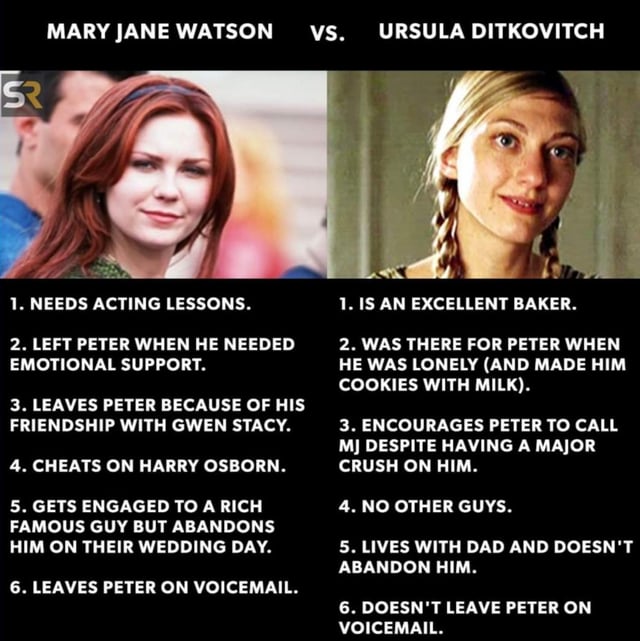
Ursula Ditkovich. The daughter of an Eastern European immigrant landlord. Shy, unglamorous, barely a footnote in the movie. She brings Peter Parker a glass of milk and a slice of chocolate cake. He is broke, bruised, and alone. She asks for nothing in return. In the third film, Peter is trying to call Mary Jane. Things between them are falling apart. Ursula walks in and asks if he is calling her. He is. She smiles and says, "I think that would be so good," and offers to make him cookies. She has feelings for him. Everyone watching knows it. But she puts his happiness ahead of her own. That is not weakness. That is a kind of strength the culture has forgotten how to name.
The film never treats her as a serious romantic option. And yet, two decades later, a stubborn internet meme insists Peter chose wrong.
You can see why. Mary Jane Watson spends three films engaged to other men, telling Peter he is "nothing to her but an empty seat" when he misses her play, and needing rescue from rooftops. The films know she is tragic, but a generation watched the tragedy and called it the template. Unavailability became mystery. Emotional chaos became depth. MJ loved Spider-Man the hero. Ursula loved Peter the person.
Ursula just showed up. Milk and cake. I see you, and I am on your side.
What happens to quiet women who still believe showing up for someone is a form of love, in a culture that has taught them self-assertion is the higher virtue? And what happens to the men who notice?
I started thinking about this because of the men closest to me.
A friend of mine had been through the usual grind. Apps, awkward dates, women who seemed to be interviewing him for a position they had not decided to fill. Then he started dating a Latina, and something shifted.
"She's making me food," he told me. "Supporting me when I work hard and late instead of complaining that I work too much. It's totally different."
Not because she lacked ambition. Because she had a different idea of what ambition was for.
Another friend married a Southern girl. Same story, different accent. She wanted to build a home, not negotiate the terms of one.
Another married a first-generation Cuban woman. She had her own career and was good at it. But before she ever got pregnant, she had already started building something on the side, a business she could run from home. By the time the baby came, it looked like the life she wanted was already waiting for her. Maybe she planned it that way. Maybe it just came together. Either way, motherhood and work became the same thing, and from the outside it looked like a woman who knew what she was building.
My own father, an American, married a Brazilian. I grew up watching what that looked like: a household that ran on partnership, not scorekeeping. And when my dad lost his job and went back to college for several years, my mom carried our family financially. She was not weak. She was not passive. She held everything together while he rebuilt. That is not submission. That is strength aimed at something bigger than yourself.
So I understand capable women. I married one. But capability was never the question. The question is direction. Does she aim that strength at outperforming the man across from her, or at building something with him? Competitor or partner. That is the fork, and the culture chose wrong.
And then there is my own story.
I spent a year in Brazil after high school. My first time back in a decade. I fell in love with the culture before I fell in love with anyone in it. The women I met were not weak. But they were close with their families. They kept their people near. There was a warmth and a directness to how they moved through the world that I had not seen growing up in the States.
Maybe it was because my mom was Brazilian. Maybe I grew up inside the thing I was looking for and did not have a name for it until I went back. Either way, something felt familiar. The warmth, the closeness, the way family was not an obligation but a gravitational center.
I met my wife through mutual friends there. I visited every few months. I knew within six months. We were engaged and married six months after that. Eleven years later, we have never had a major fight.
I could leave it there, but the timeline does not capture what it actually feels like. She learns the foods I like and makes them without being asked. She gives me honest feedback when I need it, not what I want to hear, but what I need to hear. When I am working too hard she does not compete with my work or resent it. She pulls me back. She balances me out. She cheers me on when I am locked in and knows not to interrupt when I am in flow. She challenges me to open up and express my feelings when I would rather just keep building. The care is in the details, the small daily things that no one sees but that hold everything together.
Today my wife is part of our business. My mom works with us too. My dad found stable work, but my mom became the star. We built something we can run from home, not making career the goal but making the lifestyle the goal and building the work around it. Three people in one family, all pulling toward the same thing. Not every family gets to do that, and I know it. But when it works, it is something to see.
The Proverbs 31 woman buying fields and running a business is not an abstraction in my house. It is Tuesday.
That is what support looks like when it is real. Not a grand gesture. Just someone paying attention, every day, because she decided you were worth it.
I married into the answer before I had the vocabulary for the question.
Five men. Five different women. Five different backgrounds. The common thread was not geography. It was the kind of woman who still believed that standing beside a man was not a demotion.
None of us were thinking about Genesis or Hebrew words when we found our partners. We just knew something felt right. The experience came first. The understanding of why it worked came later, and that is what sent me back to the Bible.
What "Helpmate" Actually Means
Most people hear the word "helpmate" and think "servant." They are wrong.
The Hebrew phrase in Genesis 2:18 is ezer kenegdo, a helper fit for him. Modern ears hear "helper" and assume it means "lesser." But the same word, ezer, is used elsewhere in the Old Testament to describe God Himself as the helper of Israel.
A helper, in the biblical sense, is not a subordinate. She is someone without whom the whole thing falls apart.
The helpmate is not beneath the man. She is positioned alongside him, facing the same direction, pulling toward the same goal.
The Proverbs 31 woman is not a doormat. She buys fields, runs a textile business, feeds her household, and is praised at the city gates. She is formidable. But her formidability is directed toward building her husband and children up, not toward competing with her husband for status. Ursula with the chocolate cake is a faint echo of this woman. Small gesture, same instinct.
When the culture lost this frame, it lost the ability to tell the difference between a subordinate and a partner. It assumed any woman who chose to serve her husband must have been coerced. That's the mistake, and it's everywhere.
The Passport Bros Are a Symptom
If the theology sounds abstract, the data is not. Talk to men who are actually trying to build something, a business, a family, a life, and you hear the same thing. Dating in America feels less like courtship and more like negotiation. Every interaction is a test. Every commitment contingent on the next renegotiation.
These are not misogynists. Many are the opposite: men who want to provide, protect, and build a household with a partner who actually wants one. They are finding, increasingly, that the women most receptive to that vision are not from Manhattan or Los Angeles. They are from Sao Paulo, Manila, Bangkok, the Tennessee foothills, or the pews of rural Christian churches.
On TikTok and the wider manosphere, the men who act on this instinct are called "passport bros," Western men traveling to Latin America, Southeast Asia, and Eastern Europe in search of partners who still hold traditional values. Fox News, Business Insider, and academic sociologists have all documented the trend. It is not fringe.
Sociologist Julia Meszaros, in her 2025 book Economies of Gender, studied international dating markets in Ukraine, Colombia, and the Philippines for twelve years. Her conclusion: in a chaotic economy, both men and women reach for defined gender roles as a source of stability. Economic insecurity and worldview are pulling in the same direction.
Are some of these guys running from accountability? Sure. Is there real exploitation in parts of the international dating market? Absolutely. But those failures do not explain the whole pattern. The same hunger for complementary partnership is visible in men who never leave their zip code. Men who marry devout women from their own church, who court Christian girls in Tennessee, or who find a Brazilian wife in a congregation in Orlando.
Geography is downstream. Worldview is upstream.
The U.S. fertility rate hit 1.6 births per woman in 2024, an all-time low (CDC, 2025). A record share of 40-year-olds have never been married (Pew Research, 2023). Meanwhile, researchers studying Latino populations have a name for what protects against the loneliness and depression driving these numbers: familismo, the cultural prioritization of family closeness and support. The women in this essay come from cultures where that structure is still intact. It is worth asking whether the same closeness that protects their mental health also protects their marriages.
The Ursula question is diagnostic, not nostalgic. Is the model of womanhood the culture has elevated, always competing, always optimizing, actually producing happier women? Happier men?
What This Is (and What It Isn't)
Builders, farmers, pastors, contractors, small-business owners. Men who come home tired and want a home that feels like one. They are finding that home with women who never received the memo that wifehood and motherhood are oppression. Women from immigrant households. From Southern churches. From Brazilian Christian congregations. From Filipino Catholic families.
These women are sharper, funnier, and more formidable than most of the men who court them. But they carry a worldview in which marriage is a mission rather than a performance. And that worldview is, quietly, winning.
A woman like this has recognized a particular kind of man, one who has voluntarily directed his strength toward the welfare of his household, and chosen to build her life alongside him. This is not coercion.
It is the oldest form of freedom: the freedom to trust.
None of this is a rejection of women. It is a rejection of a specific cultural script about women, and the slow, stubborn reappearance of something the Bible described in its second chapter and the culture spent a century trying to forget. A helper fit for him. A man who lays down his strength for her. A home built on covenant rather than contract.
Milk and cake at the door when a man is broken.
Milk and Cake
Sam Raimi probably did not intend any of this. But sometimes a movie sees something the director didn't.
The films cast Mary Jane as the prize and Ursula as the scenery. A generation of men raised on those films grew up and began, slowly, to suspect the casting was wrong. That suspicion, multiplied across millions of quiet kitchens and loud internet threads, is the beginning of a cultural correction.
It will not be led by pundits. It will be led by husbands coming home to wives who are glad they came.
Ursula was there the whole time. The question was never whether she existed. The question was whether Peter, whether any of us, would be wise enough to see her.
And to the women who showed up with milk and cake when the world told them to show up with a résumé: we see you. You were right.
Reply
Send me a message
Replies go straight to my inbox. I read everything.
Comments
Say something
Post anonymously, or use a name. Keep it kind.
Comments aren't wired up yet — check back soon.